
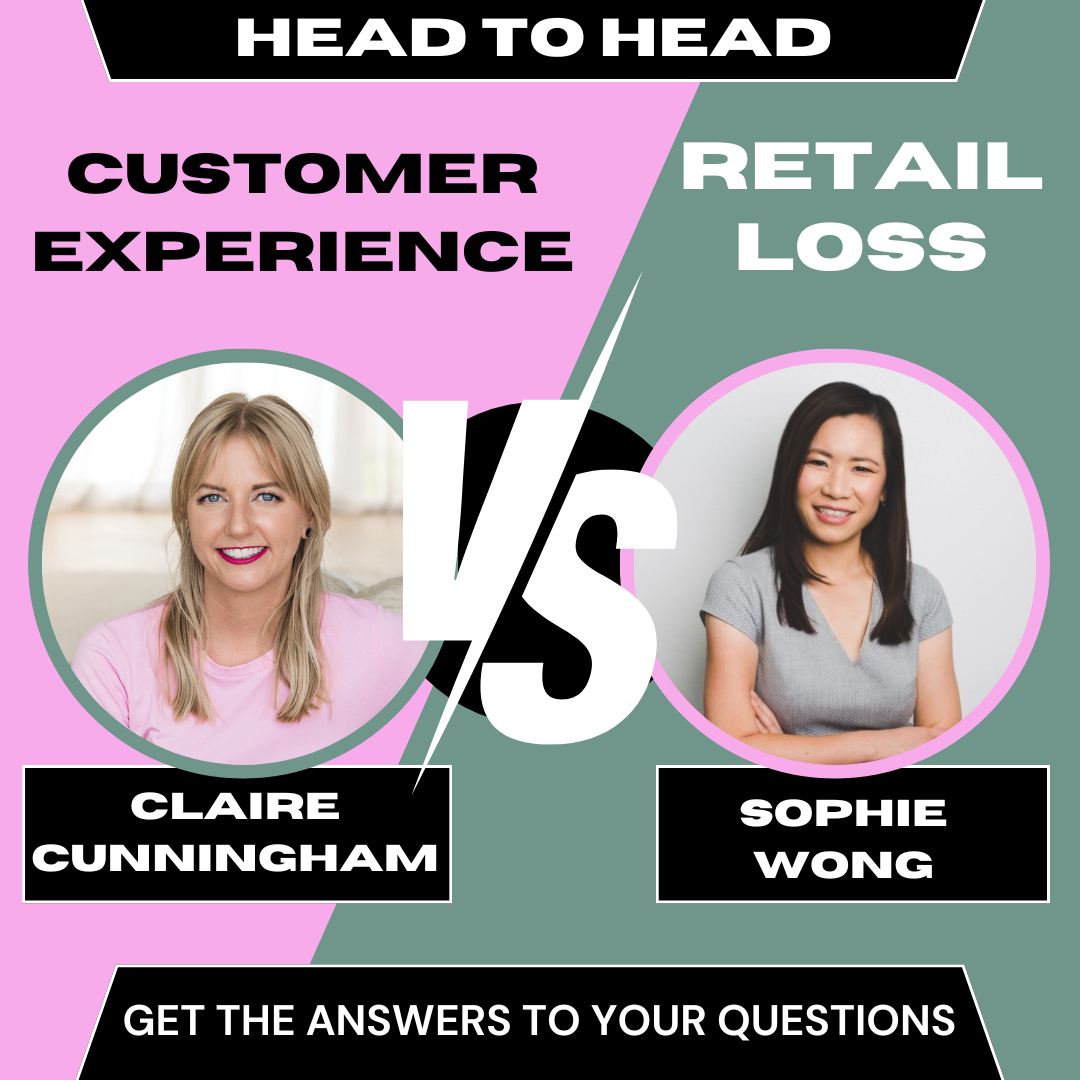
Can you reduce retail loss without ruining the customer experience?
It’s a question I hear a lot.
Whenever I talk to organisations about customer centricity, there is often a point where someone says something along the lines of:
“Yes, but we still have to protect the business.” “What about making money?” “We still need to turn a profil.”
As if somehow prioritising customers, those who spend their money with your business, would in any way negate your bottom line.
Putting customers at the centre does not mean throwing commercial reality out the window. It doesn’t mean ignoring theft, fraud or loss. And it definitely doesn’t mean letting people walk out the door without paying in the name of delivering a five-star customer experience.
In fact, I’d argue that customer experience and retail loss prevention should be working towards the same goal.
I recently sat down with Sophie Wong, founder of Positively Powered and former General Manager of Profit Protection and Service Transformation at Coles, for an episode of The Experience Gap.
We went into the conversation joking that it was going to be CX versus Loss Prevention. There wasn’t much of a fight.
The more we talked, the clearer it became: great customer experience can help reduce retail loss, and good loss prevention can create a better customer experience.
Retail loss is bigger than shoplifting
When most people hear retail loss, their brain immediately goes to someone sneaking something into a bag and walking out of a store. That’s certainly part of it. But it’s nowhere near the whole story.
Retail loss can include external theft, organised retail crime, internal fraud, supply-chain loss, process errors, stock discrepancies, waste and plenty more.
And that distinction matters.
Because if every loss-prevention decision starts with the assumption that customers are the problem, you can very quickly create an experience designed around the behaviour of a tiny minority.
What is the result of that kind of assumption?
More gates. More warnings. More interventions. More locked products. More friction.
And thousands of perfectly honest customers wondering why buying toothpaste suddenly feels like going through airport security. There has to be a better way!
Great customer service can actually reduce retail theft
One of my favourite points Sophie made in our conversation was incredibly simple: Customer service itself can be a loss-prevention tool.
Think about opportunistic theft. Someone who believes nobody has noticed them has a very different experience from someone who walks into a store and immediately hears a ‘hello’.
That interaction is good customer service for the genuine customer. But it also sends another message.
I’ve seen you. No accusation. No confrontation. No security intervention required. Just a human acknowledging another human. And sometimes that is enough.
It’s also worth separating opportunistic theft from organised retail crime. A friendly hello is obviously not going to dismantle a sophisticated criminal operation.
But that’s the point.
Retailers need to understand which problem they are actually trying to solve instead of designing every customer journey around the worst possible customer behaviour.
Sometimes ‘loss’ is actually a bad customer experience
This is particularly interesting when you look at self-service.
Not every item that leaves a self-checkout unpaid is the result of someone deliberately stealing it.
Customers make mistakes. They choose the wrong produce item. They forget something sitting underneath their trolley. They don’t understand what the machine is asking them to do. They get flustered. They don’t want to ‘make a scene’ or ‘bother the attendant’ to fix their honest make.
Anyone who has worked around self-checkout knows there can be a very fine line between customer error and loss.
And sometimes the best loss-prevention technology available is simply a team member paying attention.
I saw a great example of this recently. I was grocery shopping and an older woman was standing near the self-checkouts with just a couple of items. The staffed checkout had a long line, but she clearly wasn’t comfortable using self-service. She stood there for no more than a few seconds but it was long enough. The self-checkout attendant noticed her and walked over to assist.
The woman admitted she didn’t know how to use the machines and seemed almost embarrassed about it. The team member simply said that was completely fine and offered to show her how it worked or put the items through for her.
Such a tiny interaction. But think about everything it achieved!
The customer got through faster. She didn’t feel stupid. She learned something! She might even feel more confident about coming back.
And the retailer reduced the chance of an accidental scanning error. That is customer experience and loss prevention working together.
The answer to retail security isn’t simply more technology
Retailers are investing heavily in security technology.
Cameras. Gates. AI. Product protection. Self-checkout monitoring. Locked displays. And some of it is absolutely necessary.
The problem starts when we implement the technology first and think about the experience afterwards. Every security intervention creates a new step in someone’s journey.
If you lock a product behind a cabinet and you haven’t just changed the loss-prevention process, you’ve changed the customer journey. Now the customer needs to find a team member. So now you’ve also changed the team-member journey. Now somebody needs to receive the request, find the correct key or device, walk to the customer and unlock the product.
If the operating model hasn’t changed to support any of that, congratulations: you may have reduced one problem while creating three more.
This is why customer journey mapping should be part of loss-prevention design.
Before introducing a new intervention, ask:
- Where does this sit within the customer journey?
- What friction does it create for an honest customer?
- What does a team member now need to do differently?
- Have we given them the time, tools and training to do it?
- How will we know whether the change is actually working?
That last question is particularly important because reducing loss while destroying customer satisfaction isn’t necessarily a win. Neither is creating a beautiful experience that is commercially unsustainable.
You need both.
Stop making CX and loss different departments’ problems
This was probably the biggest theme that emerged from our conversation.
Retail loss is not just the responsibility of the Profit Protection team.
Customer experience is not just the responsibility of the CX team.
These things cut across operations, finance, technology, safety, merchandise, customer experience, leadership and frontline teams. The best solutions happen when those groups sit around the same table early enough to actually influence the outcome, not when CX gets invited in three days before launch and is asked to “make the messaging customer-friendly.”
We need to stop designing solutions department by department.
A brilliant loss-prevention initiative that causes operational chaos isn’t brilliant. A brilliant CX initiative that destroys margin isn’t brilliant either. The question should be:
How do we design something that works for the customer, the team AND the business?
That intersection is where the good stuff happens.
And please listen to your frontline teams
If you want to know where your biggest customer frustrations are, ask the people dealing with them every day.
If you want to understand where processes are breaking, ask the people using them.
If you want to know how customers are finding ways around a system, deliberately or accidentally, there is a very good chance somebody on the frontline already knows.
As Sophie put it in our conversation: “Listen to your team. They have the answers.“ But just listening isn’t enough. You have to act on what they tell you.
Coach people on the floor rather than relying entirely on another e-learning module. Show teams what good looks like. Give them processes that actually work in the real world. And make it easy for them to deliver the experience you’ve designed.
And importantly, involve the frontline team in the process from the start. Don’t make the mistake of needing to redesign the process later down the track after realising it doesn’t work in the real world.
Because ultimately, customer experience is almost always dependent on team experience. Add complexity for your people and eventually the customer feels it too.
So, customer experience or loss prevention?
Both.
Sorry. I know that isn’t nearly as exciting as declaring a winner.
Technology matters.
Security matters.
Process matters.
Data matters.
Customer experience matters.
And your people matter enormously.
There isn’t one silver bullet that suddenly fixes retail loss.
The businesses that get this right will be the ones that bring all of those pieces together and keep making the experience a little better.
For customers.
For teams.
And for the commercial health of the business.
Maybe Sophie summed it up best at the end of our conversation:
Focus on the one-percenters and get them right. Then work out how you can be 1% better every day.
That sounds like pretty good advice for loss prevention.
It also sounds like pretty good advice for customer experience.


