

Webinar Recap 29 July 2026
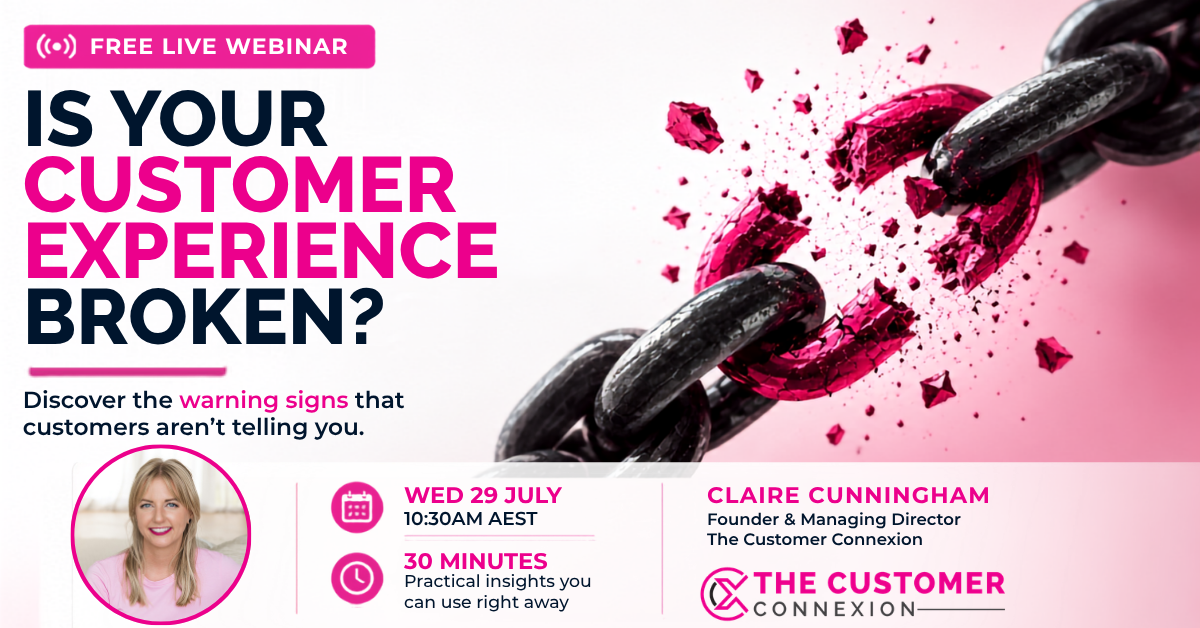
Customer experience problems are not always obvious from inside an organisation. Sometimes the warning signs are clear. Customer satisfaction scores fall, complaints rise and negative reviews begin appearing online. But more and more often, a broken customer experience isn’t loud and full of complaints.
If you missed the webinar on Wednesday 29 July, this piece recaps it but if you want to watch it in full to get all the great real world examples, checkout the recording here!
Customers encounter friction, become frustrated and simply don’t come back. They may spend less, abandon a purchase, switch to a competitor or stop recommending the business. Because they never formally complain, the organisation assumes everything is working.
In a recent Customer Connexion webinar, The Experience Gap: Is Your Customer Journey Broken?, we explored a practical way to diagnose both the obvious and less visible signs of poor customer experience.
The framework is built around four questions:
- What are customers saying?
- What are customers doing?
- What do your people know?
- What is the organisation avoiding?
1. Listen to What Customers Say
The most obvious signs of broken customer experience are usually already being talked about.
These signals may appear in customer surveys, complaints, public reviews or direct feedback.
Customer satisfaction scores are declining
A fall in Customer Satisfaction Score, Net Promoter Score or another customer measure is one of the clearest indications that something may be wrong.
However, the score itself is only a warning light. It does not necessarily explain where the problem is occurring or what needs to change.
Look beyond the headline result and ask:
- Are scores declining across the whole business or within one specific journey?
- Are certain customer groups having a noticeably worse experience?
- Do written comments match the numerical results?
- Are scores stable only because employees are manually compensating for poor systems?
It is also important to compare internal survey results with public sentiment. If customer scores appear healthy but online reviews tell a very different story, your measurement program may not be capturing the full experience.
Complaints are increasing—or there are none at all
Increasing or repeated complaints are another obvious sign of customer experience failure.
Pay particular attention when customers repeatedly raise the same issue, need to contact the organisation several times or become increasingly frustrated while seeking a resolution.
But having very few complaints is not always positive.
Most dissatisfied customers do not formally complain. A problem may be frustrating enough to make them leave, but not significant enough for them to spend time explaining it to the business.
A lack of complaints may also indicate that:
- customers do not know how to provide feedback;
- the complaints process requires too much effort;
- customers do not believe anything will change;
- the organisation has not created a trusted environment for honest feedback.
The better question is:
Have complaints reduced because the experience improved, or because customers stopped trying to tell us?
Are you asking the right questions?
Many organisations ask broad questions such as, “How satisfied were you?”
That can produce a useful benchmark, but it rarely reveals exactly where the experience became difficult.
To uncover customer friction, ask more diagnostic questions:
- What was harder than it should have been?
- At what point did you feel confused or uncertain?
- What nearly stopped you from continuing?
- What happened differently from what you expected?
- What would make you choose another provider next time?
Numerical scores tell you that something is happening. Customer comments and direct conversations are more likely to tell you why.
2. Watch What Customers Do
What customers do can be more revealing than what they say.
A customer may never leave a negative review or make a complaint. Their behaviour may still show that the experience is failing.
Customers are leaving, spending less or disappearing
Customer experience issues may appear through:
- increasing churn or cancellations;
- falling repeat purchases or renewals;
- reduced customer lifetime value;
- declining conversion;
- customers completing one transaction but never returning;
- customers becoming increasingly dependent on discounts before purchasing.
A decline in revenue does not automatically prove that customer experience is the cause. Pricing, competition, economic conditions and market changes may all play a role.
However, commercial behaviour should be treated as a signal worth investigating.
When customers spend less or disappear, organisations should explore whether friction, uncertainty, broken promises or poor service contributed to that decision.
Where are customers abandoning the journey?
One of the most useful ways to diagnose broken CX is to examine where customers stop progressing.
Where do they abandon their shopping cart, application, account creation process or booking?
When do they move from digital self-service to calling or emailing for help?
Where are they required to repeat information, restart a process or wait for another department?
Journey abandonment can reveal:
- confusing processes;
- unexpected costs or conditions;
- difficult account creation;
- poor handoffs between teams;
- inconsistent information across channels;
- a gap between marketing promises and operational delivery.
It is equally important to examine whether customers return after completing the journey.
A customer may successfully finish a purchase while still having such a frustrating experience that they decide never to come back.
Completion does not automatically equal satisfaction or loyalty.
Customers do not experience your organisational chart. They experience one organisation. When departments are disconnected, the customer is often forced to bridge the gaps.
3. Ask Your People What They Know and Observe
Frontline customer service and sales teams often understand customer friction more intimately than anyone else in the organisation.
They hear the same questions, confusion and frustration every day. They also create workarounds to help customers navigate systems that do not work as intended.
Ask your frontline teams:
- What do customers struggle with repeatedly?
- What do you apologise for most often?
- What manual workarounds have you created?
- Which policies cause the most frustration?
- Where are customers creating their own “desire paths”?
- What is the one issue that frustrates everyone?
A desire path is the unofficial route people create when the designed path is inconvenient.
In customer experience, this might look like customers contacting the wrong department because it responds faster, employees bypassing a system or customers using an unintended channel to complete a simple task.
These behaviours are valuable clues. They show where the experience has been designed around internal processes rather than customer needs.
Sometimes the customer experience appears functional only because capable, caring employees are holding it together.
That creates a risk.
Leaders may believe the process is working, while frontline employees are quietly compensating for poor systems, unclear policies or broken handoffs.
The experience is not actually fixed. It is being manually rescued.
4. Face What the Organisation Avoids
The hardest customer experience problem is often not a lack of insight.
The organisation may already know what needs to change.
Customers keep raising it. Frontline teams see it daily. It appears in every report. Leaders agree that it matters.
Yet nothing happens.
The problem may:
- have no clear owner;
- cross several departments;
- require significant operational change;
- be considered too difficult or costly;
- continually lose priority because the timing is never right;
- challenge an established culture, policy or leadership decision.
This is where CX maturity becomes important.
A mature organisation does not simply collect customer feedback. It has the ownership, capability and discipline to act on it.
A less mature organisation may be able to identify friction but still struggle to make changes because responsibility is fragmented, short-term priorities dominate or the solution requires cultural and operational courage.
The customer then continues to pay the price.
They repeat information, encounter the same barriers, become increasingly frustrated and gradually lose trust.
Sometimes broken customer experience is not a listening problem.
It is an action problem.
Where Should You Start?
You do not need to fix every customer experience issue at once.
Start by bringing together evidence from all four areas:
Listen to what customers say
Review surveys, complaints, reviews and direct conversations.
Watch what customers do
Examine churn, conversion, repeat behaviour, spend and journey abandonment.
Ask what your people know
Speak with frontline, sales, service and operational teams.
Face what the organisation avoids
Identify recurring issues that remain unresolved because they are complex, structural or uncomfortable.
Look for patterns appearing across several sources.
The most important CX problems are rarely isolated incidents. They are recurring points of friction that affect customers, employees and commercial performance.
The goal is not to produce a long list of everything that could be improved.
It is to identify the issues creating the greatest customer effort and business impact, then create a practical path to address them.
At The Customer Connexion, we help organisations uncover hidden customer friction, connect experience issues with commercial outcomes and determine what needs to be fixed first.


