
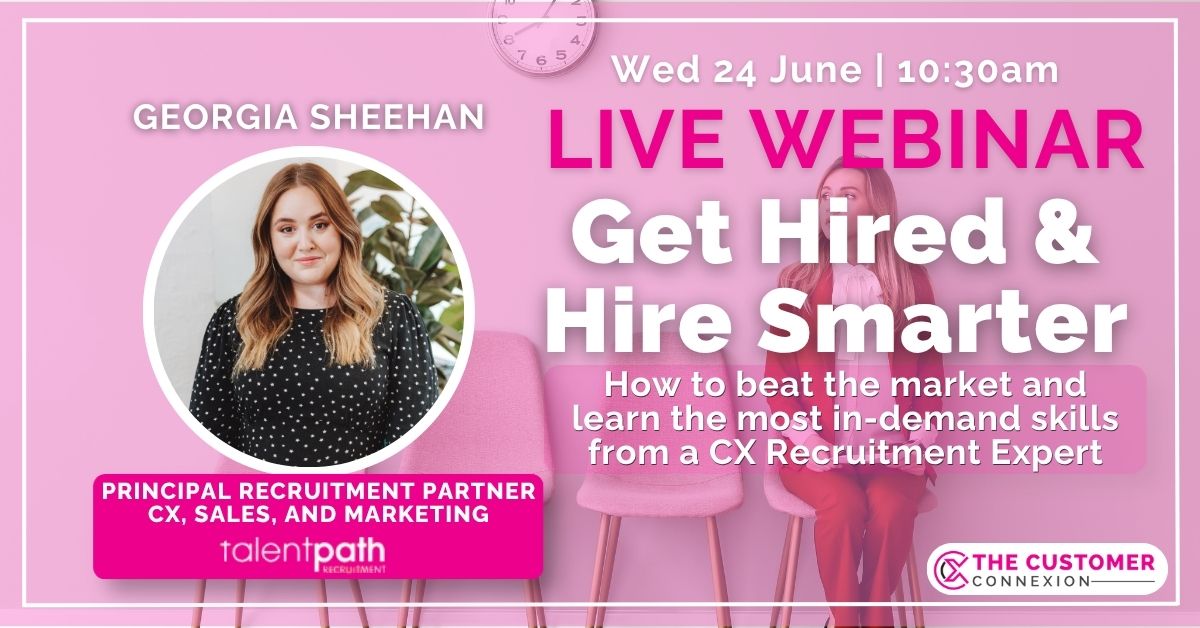
In this week’s Wednesday Webinar Series, I spoke with Georgia Sheehan, Principal Recruitment Partner for CX and Sales at Talentpath Recruitment, about the current CX recruitment market, the trends, and what employers are really looking for when hiring customer experience, sales and frontline leaders.
From changing customer expectations to AI resume screening, the conversation highlighted an important shift: while technical capability still matters, strong people skills are becoming increasingly valuable in the future of work.
For jobseekers, this means being able to clearly communicate not only what you have done, but how you work with people, lead through change and create better customer outcomes. For employers, it is a reminder that the quality of the employee experience and frontline leadership can directly shape the customer experience.
People skills are becoming more valuable in CX recruitment
As AI, automation, and new technology continue to reshape workplaces, the most forward-thinking employers are placing greater emphasis on capabilities that cannot easily be replicated by technology.
This includes skills like:
- Empathy and emotional intelligence
- Communication and relationship-building
- Curiosity and good judgement
- Adaptability and resilience
- Problem-solving
- Leadership and coaching
- The ability to understand customers and employees
These are often described as “soft skills,” but that label does not do them justice. They are increasingly critical business capabilities, particularly in customer experience, sales and service leadership roles.
Businesses still need people with technical knowledge, commercial awareness and relevant industry experience. However, Georgia highlighted that employers are also looking for candidates who can build trust, bring teams through change, understand different perspectives and create a positive environment for both customers and colleagues.
For anyone building a career in CX, this is encouraging. The ability to understand people and turn that understanding into practical improvements is a genuine competitive advantage.
Frontline connection matters for leaders
One of the strongest themes from the discussion was the importance of staying connected to frontline teams.
Leaders often have access to plenty of data: customer satisfaction scores, complaints, KPIs, dashboards, sales results and employee engagement reports. All of this information is useful, but it does not always explain what is actually happening in the customer experience.
Frontline employees are often the first to see where systems are failing, where customer expectations are not being met and where processes are making it difficult to deliver good service.
A leader who spends time listening to employees, observing customer interactions and asking what gets in the way is more likely to make practical, informed decisions.
Changing customer expectations are shaping the industry
Customer expectations are higher than ever. People want service to be simple, fast, personalised and consistent. They want to feel understood, rather than passed between channels or asked to repeat the same information.
This means businesses need employees who can balance efficiency with empathy.
In customer service and customer experience roles, employers are looking beyond someone who can simply follow a process. They want people who can read a situation, adapt their communication, resolve issues and make customers feel heard.
For leaders, the expectation is even broader. They need to build capable teams, remove unnecessary barriers and create the right conditions for employees to deliver a consistently good customer experience.
This is why people leadership and customer experience are so closely connected. A team that is unclear, unsupported or overwhelmed will struggle to deliver the kind of service customers now expect.
Resume tips: make it easy for recruiters and AI screening tools
One of the most useful practical insights from the webinar was around resumes and AI screening.
Many employers use applicant tracking systems and recruitment technology to manage large numbers of applications. These tools may scan resumes for relevant job titles, keywords, skills, qualifications and experience before a recruiter reads them in detail.
That does not mean candidates should fill their resumes with generic buzzwords or copy and paste the job ad. Instead, the goal is to be clear, specific and relevant.
When applying for a role, carefully review the job advertisement and make sure your resume reflects the language and skills genuinely connected to your experience.
Do not assume a recruiter will automatically understand the scale of your work. Explain it. Specific outcomes will always be more powerful than vague responsibilities. Georgia had some refreshing updates for the 2026 hiring market:
- If you’re an executive, it’s better to over explain and make your resume more than two pages. More is better.
- If you’re a leader or management, talk specifics. What size or type of team have you lead? What were their KPIs?
- If you’re working on the frontline, highlight the transferrable people skills that are required in any industry!
- Include your phone number. Georgia noticed more junior applicants that are not including a phone number. In a competitive market, this may cost you the first call. Include it.
- AI software scrapes for keywords associated with the job application. Include as many of those keywords as naturally as you can. Remember, a human also reads your resume too!
- Name your resume file correctly. “Georgia Sheehan Resume” is perfect. “Claire’s 2014 music industry portfolio” is not.
- Reach out directly and send your resume to a human. It never hurts to reach out to recruiters and employers to introduce yourself and get on their radar. Get your name on their brain!
Your professional personality matters
While AI may help businesses screen applications, hiring is still a human process.
Recruiters and hiring managers are not simply looking for a list of technical skills. They are assessing whether someone is the right cultural fit, is a thought leader in their industry, communicates clearly, and brings the right level of energy to a role.
That means let your professional personality stand out on LinkedIn! Georgia gave us some major tips that help you stand out to recruiters and employers alike on LinkedIn:
- Utilise your LinkedIn profile photo effectively. It doesn’t have to be a professional headshot, but take your sunnies off, show off your beautiful smile, and make sure people can identify you’re a real human being.
- Post your thoughts about your industry, what you’re up to, who you caught up with and what events you’re attending. Add a personal flair so your communication style shines through.
- The most information listed in your jobs the better. The recruitment side of LinkedIn is powerful and can find specific candidates for niche roles so beef out the experience section!
- Personalise your about me! Don’t underutilise this section! This is a great way to show who you are to someone who might want to hire you. Make it personal, specific, and special.
The future of CX is human (with a little help)
The key takeaway from my conversation with Georgia was that the future of recruitment is not solely about technical expertise, AI knowledge, or having the most polished resume.
It is about being able to demonstrate that you understand people.
For customer experience professionals, sales leaders and frontline managers, this means showing how you create connection, respond to change, solve problems and improve outcomes for customers and employees alike.
Technology will continue to change how businesses recruit and operate. But the ability to build trust, lead people and understand human behaviour will only become more important.


