
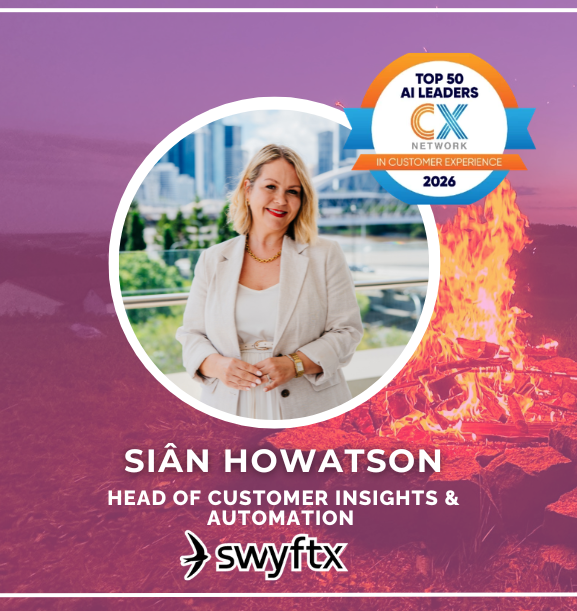
On Wednesday 22 April, I sat down with Siân Howatson, Head of Customer Insights & Automation at Swyftx, for a candid fireside chat on what it really looks like to implement AI in customer experience.
We unpacked what it actually takes to implement AI successfully, beyond the hype. From knowledge bases to ROI, this was a real-world look at how AI can improve customer service when done properly.
Why AI in Customer Experience Starts With Your Knowledge Base
One of the clearest takeaways was this: AI is only as good as the information you give it.
At Swyftx, a huge amount of effort went into getting their knowledge base into shape before expecting any meaningful results from their AI agent, Fin (by Intercom). If the content wasn’t accurate, structured, and complete, the AI simply couldn’t do its job properly.
This is where many organisations go wrong. They plug in AI and expect magic, without fixing the underlying experience. Coming from a background of knowledge management, Siân understood how important this was from the get go. She was clear, if your knowledge base is messy, outdated, or written purely for humans, your AI will not work.
Designing Content for AI and Humans
A key insight from the conversation was how differently AI and humans interpret content.
For example, headings are critical for AI. They help systems like Fin by Intercom (their chosen AI Agent) quickly identify and retrieve the right information. But humans often interpret headings more loosely.
This means businesses need to rethink how they structure content:
- Clear, specific headings improve AI accuracy
- Well-organised articles improve customer experience
- Consistent formatting supports both humans and AI
If you’re investing in AI customer support tools, it is critical that your knowledge base is optimised and up to date. Siân’s tip? Start with your top 10 most common support tickets and build from there.
Continuous Feedback Improves AI Performance
AI in CX is not a “set and forget” solution. At Swyftx, customer feedback and staff feedback were constantly used to refine how the AI agent responded. This created an ongoing improvement loop:
- Identify where the AI fails
- Understand the root cause
- Update content or logic
- Measure performance improvements
This is how AI in customer service becomes more effective over time. Without feedback loops, AI stagnates. With them, it continuously improves. Without listening to both your customers and staff, you’ll be flying blind, risking underutilisation of an expensive tool!
Measuring AI Success: Focus on Resolution, Not Just Volume
One of the most important parts of AI implementation is proving its impact.
Swyftx focused on metrics that matter, particularly resolution rate. This measures whether the AI actually solved the customer’s issue, not just responded. This is critical for demonstrating AI ROI in customer experience.
Many organisations focus on:
- Ticket deflection
- Volume handled
- Response time
But if customers still need to follow up, the experience hasn’t improved. Resolution is what drives both customer satisfaction and operational efficiency. Before implementing your AI, Siân stressed the importance of understanding and agreeing on the metrics that mattered most. Why were they bringing in the new tool? What were they trying to achieve? That became their north star.
Upskilling Teams to Work With AI
One of the biggest fears of AI is replacing jobs, particularly entry level customer roles. Siân and her team worked hard to integrate Fin as a tool that improved the customer experience, and freed up team to focus on more critical customer issues and dedicate the time they deserved.
Not only that, Swyftx invested heavily in upskilling their team to operate within the AI system. Staff were empowered to:
- Improve AI responses
- Identify knowledge gaps
- Handle complex customer issues
- Continuously optimise the experience
This is a key success factor in AI transformation in CX. The best-performing organisations treat AI as a tool that enhances their team, not replaces it. In addition, frontline team gained a valuable skill set in understanding how to support and best build AI agents that optimised the journey rather than hindered it.
Transparency Builds Customer Trust in AI
Another standout approach was transparency.
Swyftx was upfront with customers about when they were interacting with an AI agent. There was no attempt to hide it. This matters for customer trust in AI and it enabled them to collect rich data on what customers did once they realised they were speaking with AI instead of a person.
When customers know they’re engaging with AI:
- Expectations are clearer
- Frustration is reduced
- Trust is maintained
In an era where AI can feel impersonal, honesty becomes a competitive advantage. Customers are smart. They’ll work out that it’s AI they’re talking to. If you aren’t upfront with it right away, that could be the difference between brand trust and reputation damage.
The Reality of AI in Customer Experience
If there’s one thing this conversation reinforced, it’s that successful AI in CX isn’t about the technology alone. It comes down to:
- A strong, structured knowledge base
- Content designed for both AI and humans
- Continuous human feedback from customers and employees
- Clear measurement of ROI and performance
- Investment in people and capability building
- Transparency with customers
AI has the potential to transform customer experience and customer service operations. But only when it’s implemented with intention and a clear focus on customer outcomes.
Otherwise, it’s just another, expensive and underutilised tool.


