
The Problem With Customer Experience? Proving What It’s Worth
Customer Experience has a revenue-proof problem and nobody knows how to fix it.
Most businesses understand, at least in principle, that happier customers are more likely to stay, buy again, recommend a brand, and spend more over time.
But operators and CX professionals alike get stuck on showing a hard dollar value of a happy customer.
It is relatively easy to put a dollar value against a marketing campaign, a sales target or a cost reduction initiative. Customer Experience can feel much less tangible.
How much is an easier checkout process worth?
What is the financial value of reducing frustration?
Did improving a customer journey actually increase retention, or would those customers have stayed anyway?
And when businesses are making investment decisions, CX is often competing with areas that appear much easier to quantify: acquisition, advertising, automation, sales and profit protection.
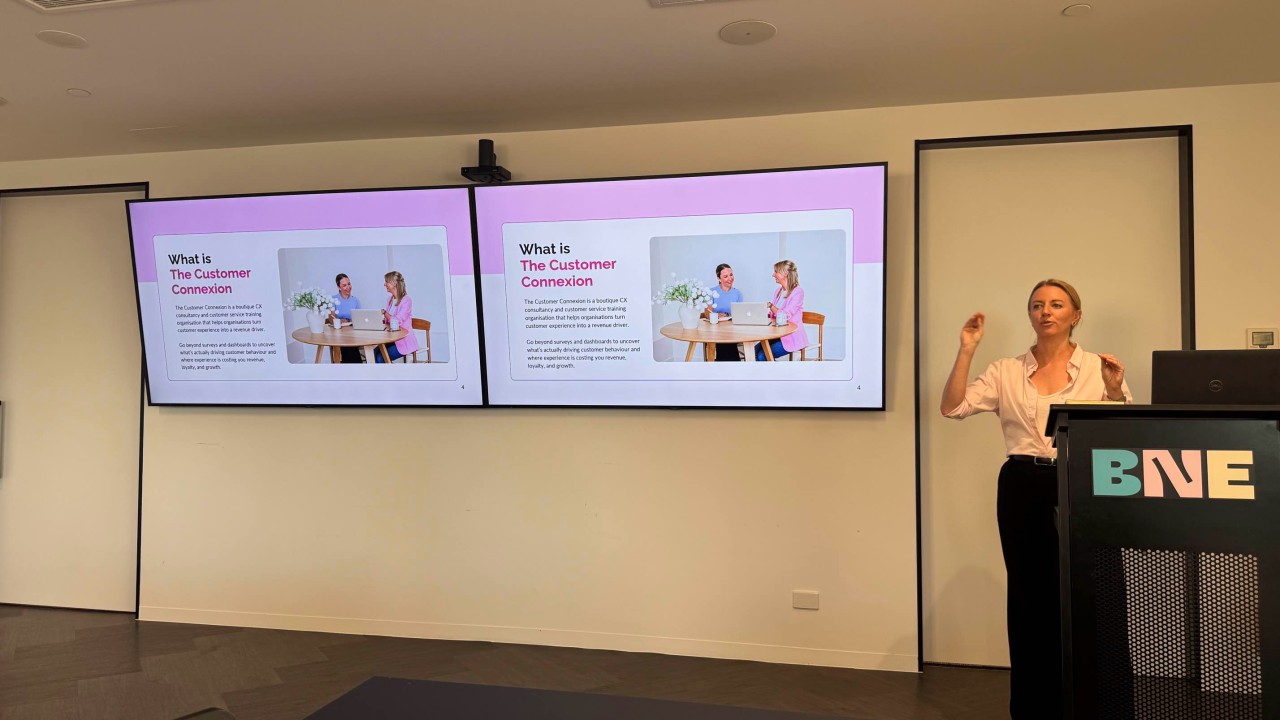
That was the focus of my recent workshop at Brisbane Business Hub: The Million Dollar ROI of Customer Experience – Linking CX to Revenue.
Rather than treating CX as something soft or separate from commercial performance, we looked at how businesses can connect the experience customers have to the behaviours and ultimately to the financial outcomes that come with improved experience.
Short-term profit can create long-term CX problems
One of my favourite examples is Blockbuster.
For years, late fees weren’t simply an inconvenience for customers, they were actually the #1 complaint. But the business had a strong financial incentive to keep them since they were a significant part of their business model, almost 10% of its overall revenue in 2004.
Then along came alternatives such as Netflix (and pirating), offering the market something with no due dates and late fees, while also making accessing movies more convenient.
Blockbuster’s decline didn’t simply happen because they were charging late fees, it’s because they ignored consistent customer feedback and monetised friction points rather than adapt to chaning market demands.
This is a brilliant example of a much broader CX problem: What happens when something generating revenue for your business is actively making the customer experience worse?
Businesses can become very good at optimising short-term financial outcomes while unintentionally eroding trust, loyalty or future customer value.
A friction point can make money today while simultaneously giving customers a reason to leave tomorrow.
Compare that with Costco
Costco takes a very different approach.
Its commercial model relies heavily on creating enough ongoing value that customers continue to pay for the priviledge of shopping there.
Rather than attempting to maximise margin on every individual transaction, the broader proposition is built around value, pricing discipline, and loyalty.
Globally, almost 90% of Costco members renew their memberships. That’s an incredibly simple example of Customer Experience becoming commercial behaviour.
Customers perceive value > They pay to renew their membership. > That renewal creates recurring revenue.
Interestingly Costco does not send out a membership survey. While you can provide feedback through many channels, they’ve skipped the sentiment metric and went straight to commercial value by using the membership renewal rate as their customer satisfaction metric.
They’ve effectively asked, “Did we provide you enough value for you to renew your membership with us another year?”
This is why businesses like Costco, Bunnings Warehouse, and Amazon are interesting CX examples. Their customer propositions aren’t simply marketing messages sitting on top of the business, instead the way customers perceive the value of the business is what drives that strategy and operations.
A customer-centric strategy isn’t necessarily about providing extravagant service or making every customer delighted at any cost. We’ve learned over and over that one-off delights don’t build long-term customer loyalty.
Instead it’s about creating customer value and ease over time that creates an unstoppable business model.
So how do we actually prove CX ROI?
During the workshop we explored three practical ways organisations can make the commercial impact of CX easier to see for the broader organisation.
1. Stop measuring customer sentiment in isolation
NPS, CSAT, CES, complaints, reviews and customer feedback are valuable. But they aren’t the end of the measurement process, they’re just signals on how customers FEEL about your business. The trick is uncovering the dollar value of those feelings.
Start by asking: What customer behaviour changes when that metric changes?
Then ask; What does that behaviour cost the business?
If CSAT improves, does retention improve?
Do customers spend more?
Do complaints decrease?
Does conversion increase?
Do repeat purchases increase?
Does customer lifetime value change?
Instead of simply reporting that CSAT increased by five points, try to understand what commercially relevant behaviour moved alongside it.
The objective is to build the bridge: Customer sentiment → customer behaviour → commercial impact.
That is where CX begins to move from an interesting dashboard metric to a business metric.
2. Look for operational savings
CX ROI doesn’t always appear as additional revenue. Sometimes the biggest financial benefit comes from removing unnecessary cost in unexpected places.
A poorly designed customer journey often creates operational consequences somewhere else in the organisation.
Customers call because they can’t find information.
They contact support multiple times because their issue wasn’t resolved the first time.
Employees spend time correcting inaccurate orders.
Long queues require additional labour.
Poor processes result in compensation, refunds or rework.
Improving Customer Experience can therefore improve metrics such as:
- First Contact Resolution
- enquiry or call volume
- cost-to-serve
- transaction accuracy
- employee efficiency
- wait times
- compensation and refunds
This is an important shift in thinking. A CX initiative doesn’t necessarily need to generate another million dollars in sales to create a million dollars in value.
Saving a million dollars unnecessarily leaving the business is still a financial impact discovered through customer signals.
3. Test CX like you would test anything else
One reason CX ROI can be difficult to demonstrate is that organisations sometimes make large changes across an entire business and then attempt to determine what caused the result.
A better approach can be to start smaller. Test a new service model in one store. Trial different signage.
Introduce a digital journey improvement to one customer group like a different email template.
Then compare it to your control group that didn’t have the update.
What changed or what didn’t?
What did customers do differently?
What happened to the financial or operational metrics? Did anything unexpected happen?
Finding the smallest possible environment in which you canobserve and test an initiative makes it considerably easier to build a commercial case before scaling investment.
CX doesn’t always need a perfect attribution model, after all humans don’t always behave perfectly! But a great comparison experiment paves the way for a broader change.
The real challenge isn’t whether CX has value, it absolutely does.
The challenge is whether the rest of your organisation can see the monetary value.
Customer Experience naturally sits across multiple departments, systems, interactions and stages of the customer journey. That makes it a lot harder to measure than a single sales or marketing campaign.
But difficult to measure doesn’t mean impossible to measure.
The starting point is connecting the dots:
What is the customer experiencing?
What behaviour is that experience driving?
What does that behaviour cost or contribute to the business?
Once businesses begin asking those questions, CX becomes much easier to discuss in the language organisations ultimately understand: revenue, growth, retention, efficiency and cost.
And that’s how you can get the rest of your organisation to stop seeing Customer Experience as a nice-to-have and instead becoming your commercial growth strategy.


