
The Problem: The Billion-Dollar Perception Gap
For too long, Customer Experience (CX) has been marginalized as the “fluffy” department—a cost center focused on “empathy” while the rest of the C-suite speaks the language of Net Revenue Retention (NRR) and EBITDA. This disconnect is financially reckless. The data is unambiguous: Harvard Business Review research reveals that customers spend 140% more on brands that deliver superior experiences than those that do not.
Most people can tell you in plain english that if a customer experience is poor, confusing, or just too difficult, they won’t keep spending their dollars there. Fundamentally we understand that bad experiences = lost sales and good experiences = more sales.
So why then do we struggle to articulate that to the board? The business manager? The C-Suite?
It’s because CX practitioners are using the wrong metrics and speaking the wrong language.
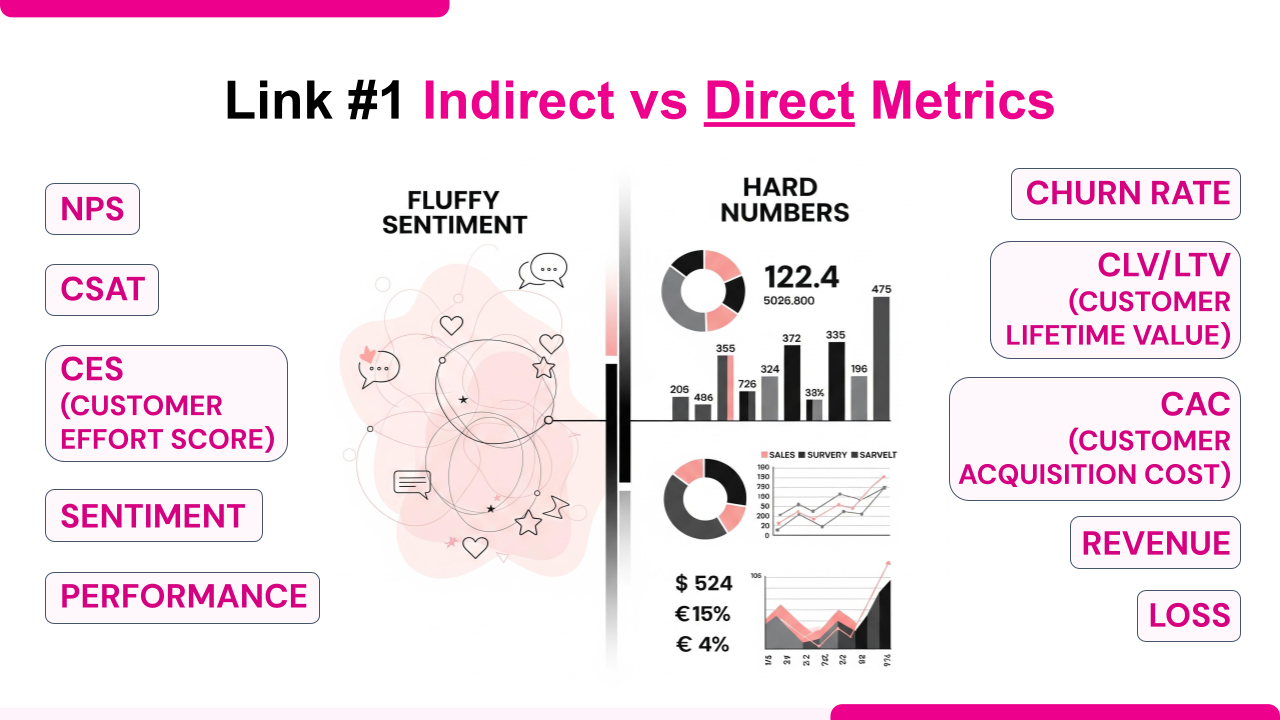
Link #1 Indirect vs Direct Metrics
In the realm of customer experience, direct metrics are those that communicate value and opportunity in tangible business terms, such as revenue growth, market share, churn rate, and customer lifetime value (CLV). These metrics are best suited for building a compelling, outcome-backed investment case because they directly attribute commercial results to CX efforts. Conversely, indirect metrics serve as performance indicators that suggest where a business can look to improve its existing CX. These include sentiment-based measures like NPS and CSAT, as well as operational efficiency indicators such as first-contact resolution (FCR) and transaction accuracy. While indirect metrics are vital for operational investigation and “closing the loop” with customers, they are limited in their ability to translate into immediate commercial impact, meaning ROI-seekers should prioritize direct metrics to speak the language of executives and shareholders.
We need to be talking about the “Why” with indirect metrics, but show the financial outcome with the direct metrics. ie. NPS has increased 5 points which resulted in our Customer Aquisition Cost decresing $2 per customer.
Huge CX financial win.
Link #2 Find Operational Cost Savings
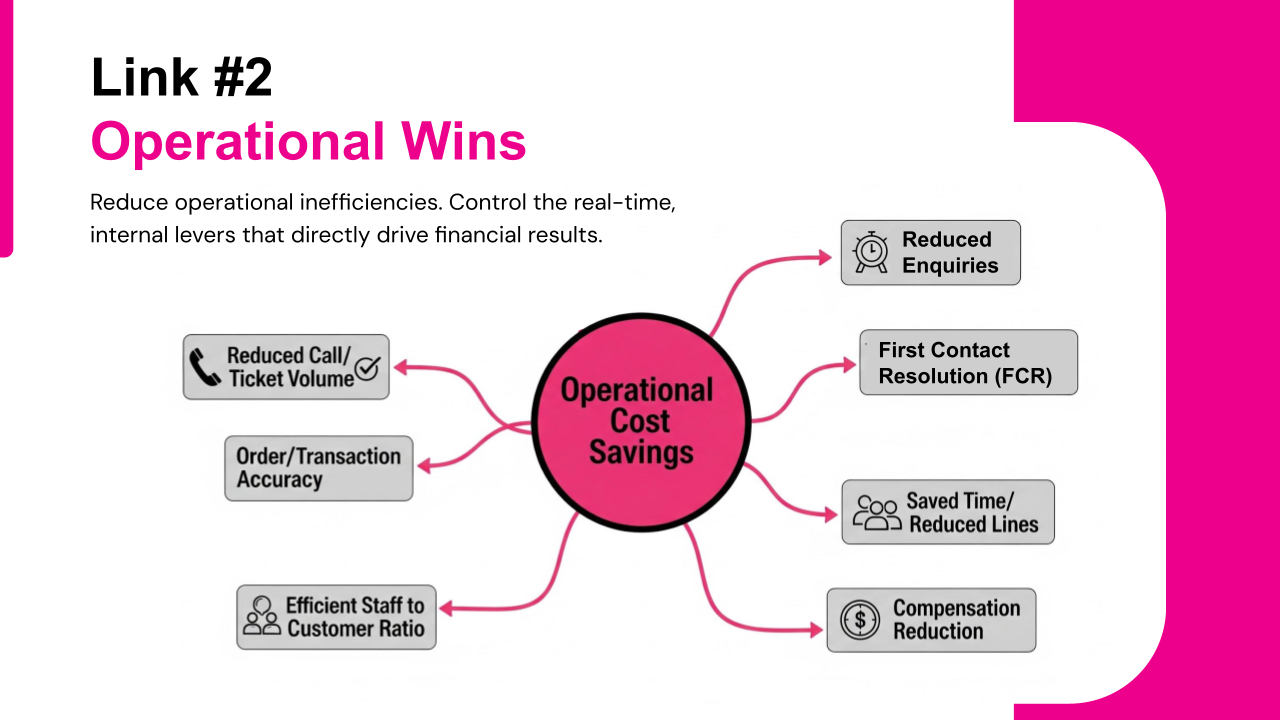
Driving revenue doesn’t have to be all about new sales or retention, it can also be about operational cost savings.
What friction points are happening internally for staff that are in-turn causing problems for customers?
To find operational cost savings, organizations should focus on reducing inefficiencies by controlling real-time internal levers such as First Contact Resolution (FCR), order accuracy, and the employee-to-customer ratio,. High-friction touchpoints, such as complex billing journeys, can be simplified to significantly decrease customer service calls and save millions in annual operating costs,. Implementing self-service solutions like AI chatbots and FAQs empowers customers to resolve issues independently, leading to an estimated 20% reduction in support costs. Additionally, businesses can identify digital innovation opportunities by analyzing journeys that generate high call volumes—typically more than six calls per customer—to proactively streamline the cost to serve. Leveraging AI-driven predictive models further optimizes savings by minimizing inbound calls and tailoring compensation outlays to specific at-risk segments rather than using blanket voucher offerings,.
Link #3 A/B Test Results
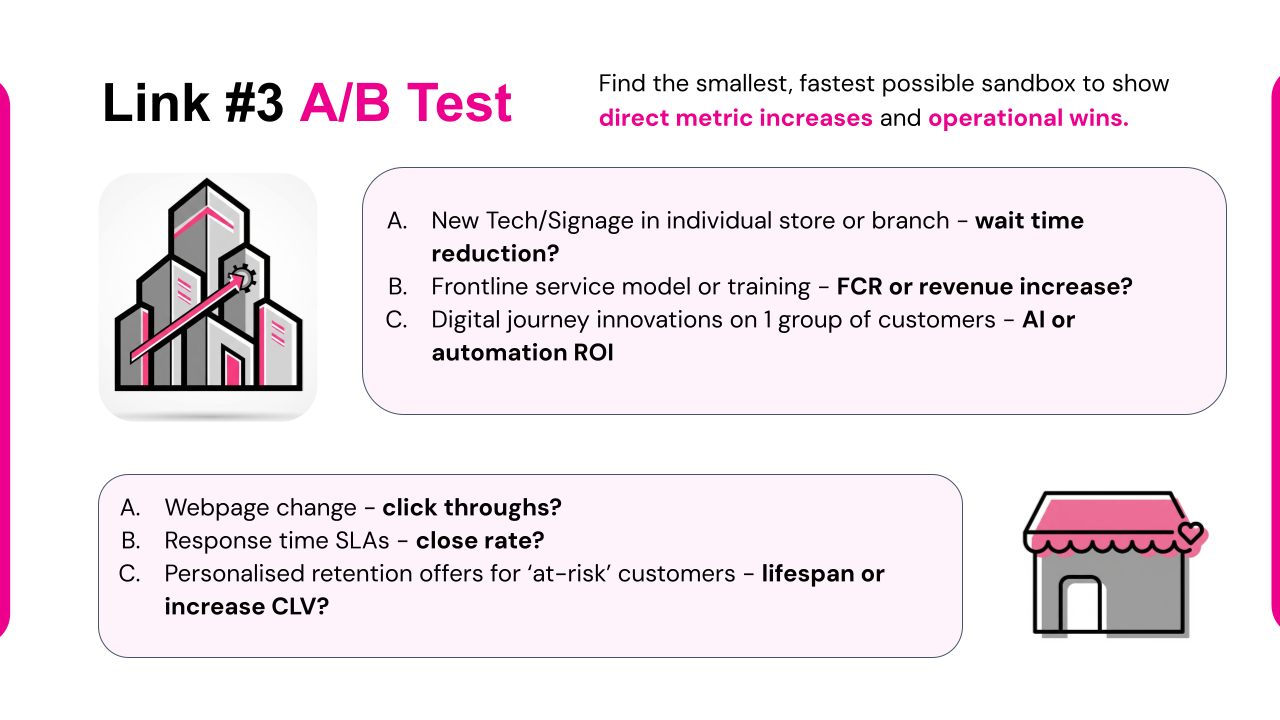
A/B Testing is the gold standard to show the impact a better and improved customer experience had on revenue or operational cost.
Find the smallest possible environment you can test a concept and move the conversation from simple correlation to proof of causation,. By implementing a specific change in a dedicated “test” group while keeping a similar “control” group unchanged, teams can measure the exact financial lift in metrics like total sales, conversion rates, or customer lifespan.
This “sandbox” approach allows firms to calculate a hard-nosed ROI. It demonstrates the bankable value of an investment before scaling it across the entire organisation.
These are the best starting blocks to help you tackle the “feel-good, fluffy” argument perpatuating the cost-centre myth around the business and help you reposition CX as the revenue driver that it is!


